Single units to 120 tonnes, with 212 tonnes already delivered
Flat racks, open tops, tank and reefer containers, breakbulk and charter
Route surveys, lashing plans and lift supervision by our own engineers
Project cargo is the part of freight where the standard answers stop working. The unit will not fit in a container, the route has a bridge that will not clear it, the crane at the destination port is rated below what you need, and the permit application takes longer than the sailing. Each of those is solvable, but only if someone surveys the route before the cargo is built rather than after it is sitting on a quay.
E-AndEx handles out-of-gauge and breakbulk movements up to 120 tonnes as standard, and has delivered single units considerably heavier — most recently a 212-tonne marine diesel engine imported from Korea, where customs declaration, multimodal routing and thousand-tonne-class lift supervision were delivered as one scope from load port to workshop floor. We also run plant relocations, bulk and RoRo chartering, and equipment imports for foreign-invested manufacturing sites in China.
Start with the dimensions, the weight, the lifting points and the two end addresses. Everything else follows from those four. We run a route survey against them — bridge and tunnel clearances, road weight limits, turning radii, crane capacity at both ends and any seasonal restriction on the corridor — and come back with the routing that actually works, the equipment it needs and the permits it will require. This stage is unglamorous and it is where project shipments are won or lost.
Once the method is agreed, we handle the permit applications, engineer the lashing and stowage plan, arrange the cranes and modular trailers, and put our own supervisor on site for the lift. Customs declaration runs through our AEO-Advanced brokerage in parallel rather than afterwards, so the paperwork is not what holds a 200-tonne unit on a quay. You get one scope, one contract and one coordinator from origin to final position.
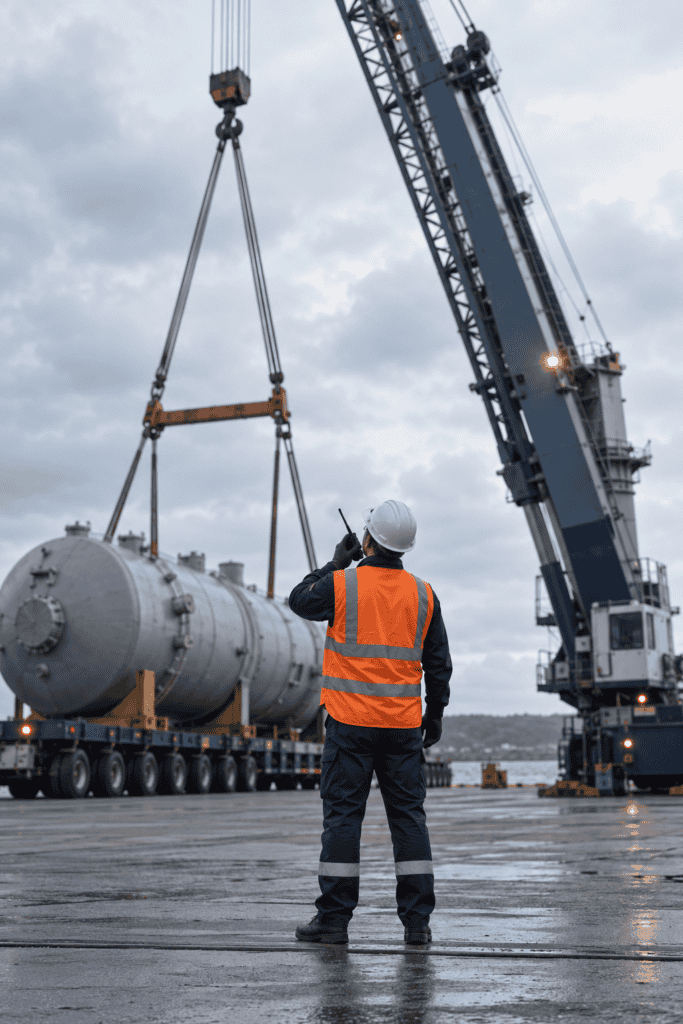
Bridge and tunnel clearances, road weight limits, turning radii and crane capacity checked at both ends before anything is committed, with the permit timeline built into the schedule rather than discovered late.
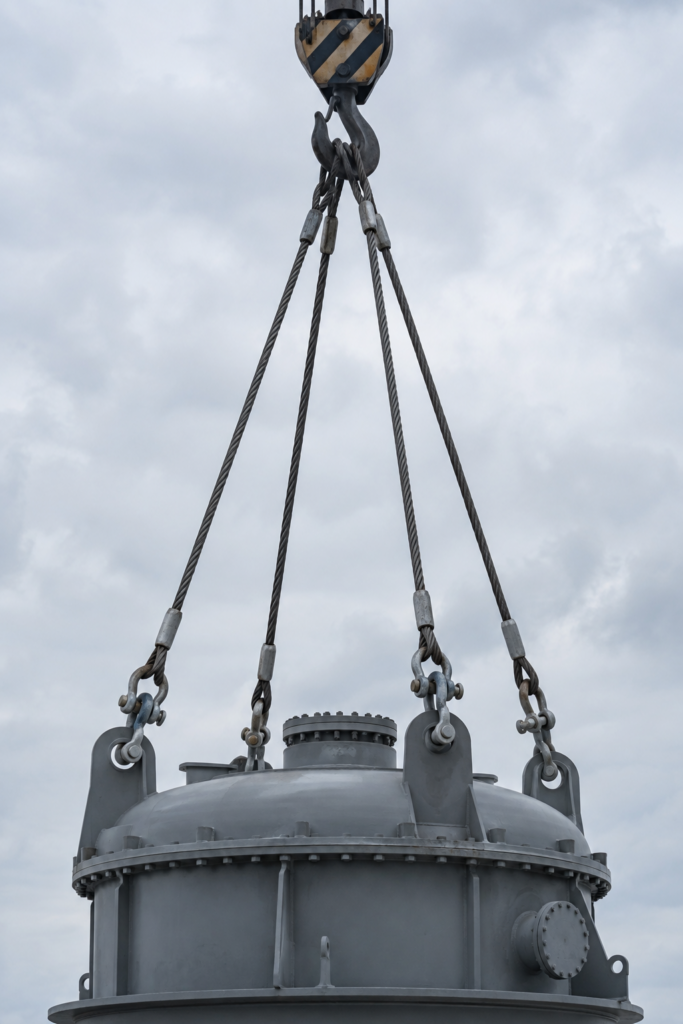
Lashing and stowage plans engineered for the specific unit, cranes and modular trailers arranged to the required rating, and our own supervisor present for every lift.
Oversized-load permits, port approvals and AEO-Advanced customs clearance progressed alongside the physical planning, so documentation is never the reason a unit sits on a quay.
A standard container moves itself. A 200-tonne unit moves because someone measured a bridge six weeks earlier. Most forwarders will quote project cargo and then subcontract every technical decision to a heavy-lift specialist you never meet — which is fine until something needs deciding at two in the morning on a quay.
+86 532 8697 3601
2F, Building 23, Guanggu Software Park, 396 Emeishan Road, Huangdao District, Qingdao, China
We handle single pieces up to 120 tonnes as standard, and have delivered considerably heavier — most recently a 212-tonne marine diesel engine, using modular trailers, thousand-tonne-class cranes and hydraulic jacking systems with our own engineers supervising on site. Send us the dimensions, the weight and the lifting point positions and we will confirm the route and the permits before you commit to anything.
Flat racks and open tops work when the cargo exceeds container dimensions but still fits within the handling envelope of a container terminal — typically up to around 40 tonnes with moderate overhang. Beyond that, or where the unit cannot be secured to a rack, breakbulk or charter is the answer. Cost, transit time and destination port capability all shift between the two, so we usually price both and show you the trade-off rather than deciding for you.
Earlier than most people expect. The route survey takes one to two weeks, oversized-load permits commonly take three to six weeks depending on the provinces crossed, and breakbulk sailings are far less frequent than container services. For a single out-of-gauge piece, eight weeks is comfortable. For a plant relocation, start six months out. If your date is already tight, tell us — sometimes the constraint is solvable and sometimes it genuinely is not, and you should hear which one it is straight away.
Inland movement of an over-dimension or overweight load requires a road transport permit from the traffic authority of every province the route crosses, with the approved route, timing and any escort requirement specified. Port entry may need separate approval, and the lift itself may require a crane operation plan filed with the terminal. We handle all of it, but the permit timeline is usually the longest single item in the schedule, which is why the route survey comes first.
Yes. A plant move is a sequencing problem before it is a transport problem — critical equipment has to be the last out and the first in, or the new site sits idle waiting for a machine that was loaded first. We use 3D scan modelling to plan the dismantling and re-erection order, handle the hydraulic jacking of large assemblies, and manage the movement so production restarts without a gap.
Liability depends on the contract and the incoterm, and for project cargo it is worth settling before the equipment moves rather than after. We carry standard forwarder liability, but for high-value units we recommend project-specific marine cargo insurance covering the full origin-to-final-position scope including the lifts. We will tell you what the policy needs to specify and can arrange it as part of the scope.
Send us the dimensions and weight and we will tell you whether it is feasible before you plan around it.