Most guidance on shipping out of China is written for buyers in Europe and North America. Intra-Asian trade is enormous, growing faster, and covered in a fraction of the detail — which leaves buyers in Vietnam, Indonesia and across the region working from guidance written for a completely different journey.
This lane is different in three ways that matter. Transit times are short enough that customs delays dominate the schedule rather than the sailing. A free trade agreement can take your duty to zero if the paperwork is right. And for Vietnam, road freight is a genuine alternative to sea. This article covers all three, plus what actually happens at the destination end — the part most forwarders leave vague because they do not control it.
Sea freight is the default and the cheapest, with typical transit of roughly a week to Vietnam and ten days to two weeks to Indonesia from northern Chinese ports, considerably less from the south. Road freight is viable to Vietnam and often faster. But the largest single lever on your landed cost is not the freight rate — it is whether your shipment qualifies for ACFTA preferential duty under a Form E certificate of origin, which on many products is the difference between paying duty and paying none.
The ASEAN–China Free Trade Area gives preferential tariff treatment to qualifying goods moving between China and ASEAN member states. The instrument that claims it is a **Form E certificate of origin**.
The effect is not marginal. One published example puts the general tariff rate for a category of copper articles at 10% against an ACFTA preferential rate of **0%**. On a shipment of any size, that dwarfs whatever you negotiated on the freight.
Yet Form E is routinely missed — either because nobody raised it, or because the goods failed to qualify for a reason that could have been fixed at the order stage.
Two routes to qualification. Either the goods meet a **product-specific rule** in the ACFTA schedule for their tariff line, or they achieve a **Regional Value Content of at least 40%**.
Regional value content is the part that trips people up. It measures how much of the product’s value originates within the free trade area. Goods assembled in China from largely non-ACFTA components may not reach the threshold even though they were unquestionably manufactured in China.
This is worth establishing **before** you place the order, not after the goods are made. If the value content falls short, sometimes a change in component sourcing brings it over the line — and that conversation is possible at the design stage and impossible at the port.
Four causes account for most rejections, and all four are avoidable.
**Mismatched references.** The certificate must reconcile with the invoice, packing list and bill of lading. Any inconsistency in quantity, value, description or reference numbers can invalidate it.
**Expired originals.** Where a back-to-back certificate is issued, the original must still be valid at the point of issue.
**Alteration or repackaging in storage.** If goods are altered or repacked between issue and import, the certificate may no longer describe what arrives.
**Unauthorised warehouses or issuing authorities.** Both the storage location and the issuing body must be recognised under the agreement.
The pattern is that these failures happen in the gap between parties — the supplier arranges the certificate, a warehouse repacks, a forwarder ships, and nobody checks that the documents still describe the same consignment. Whoever handles your documentation should be reconciling all of it before departure.
Almost all of them, which means the question is really about proximity to your supplier rather than port capability.
Southern ports — Shenzhen, Guangzhou, Xiamen — have the shortest sea transit and the highest sailing frequency to the region, and are the natural choice for cargo produced in the Pearl River Delta or Fujian.
Eastern ports — Shanghai and Ningbo — serve the Yangtze delta with good frequency and slightly longer transit.
Northern ports — Qingdao, Tianjin, Dalian — add a few days of sea transit but save considerably more in inland haulage for cargo produced in Shandong or northern China. Qingdao in particular has developed as a hub for RCEP trade, which includes all the ASEAN destinations.
The rule from every other lane applies here too: the inland leg usually outweighs the difference between ports. Ship from whichever is closest to the factory unless there is a specific reason not to.
| Route | Indicative sea transit |
|---|---|
| Southern China → Ho Chi Minh / Haiphong | ~3–6 days |
| Shanghai / Ningbo → Vietnam | ~5–9 days |
| Northern China → Vietnam | ~7–12 days |
| Southern China → Jakarta / Surabaya | ~7–10 days |
| Shanghai / Ningbo → Indonesia | ~9–13 days |
| Northern China → Indonesia | ~10–15 days |
Indicative planning ranges. Confirm current schedules before committing to a date.
What is distinctive about this lane is the ratio. On a China–Europe shipment, thirty-five days at sea makes a two-day customs query look trivial. On a five-day sailing to Vietnam, the same two-day query is nearly half your transit time again.
That inversion is why destination clearance matters more here than on any long-haul lane, and why the sections below on Vietnam and Indonesia are the ones worth reading twice.
Yes, and on many shipments it beats sea freight on both time and total cost.
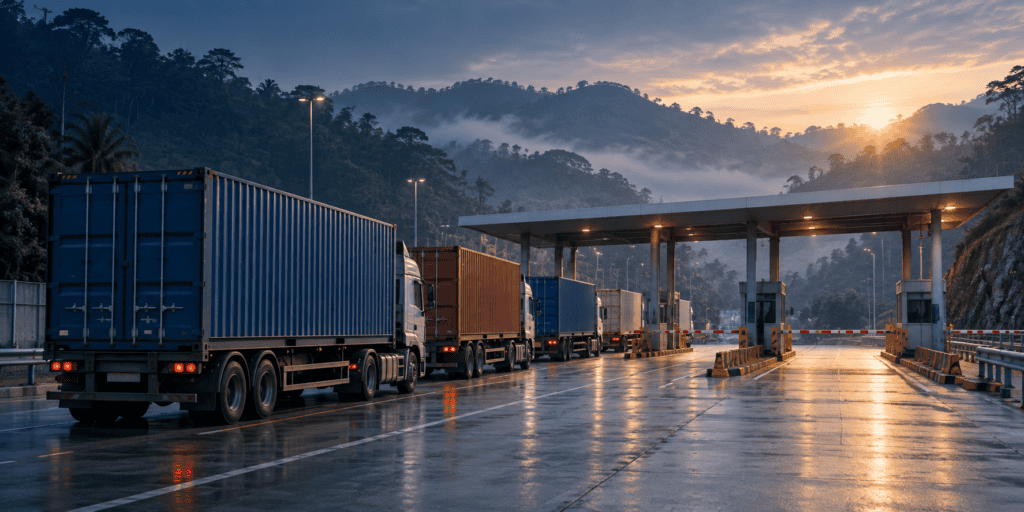
China and Vietnam share a land border with several established freight crossings. The principal one is **Youyiguan on the Chinese side, Huu Nghi on the Vietnamese** — the main road gateway, in Pingxiang, Guangxi. Other crossings include Hekou–Lao Cai in the north-west and Dongxing–Mong Cai on the coast.
Cross-border trucking suits time-sensitive cargo, moderate volumes that do not fill a container efficiently, and cargo originating in southern or south-western China where the road distance is genuinely short. It removes the port-to-port handling at both ends, which on a short sea leg is a significant proportion of the total time.
What to know: border processing is the variable, not the driving. Queue times at the crossings fluctuate with volume and with policy, and the documentation must satisfy both customs authorities. Cargo restrictions apply to road crossings that may not apply to sea.
We maintain a branch at Pingxiang, on the Chinese side of the main crossing. Most forwarders quoting this lane will offer you sea only, because road requires presence at the border rather than a booking system.
Yes, and it is more useful on this lane than on most.
Because transit times are short, the consolidation window that makes LCL painful on long-haul routes is proportionally more significant here — but the volumes moving are high enough that consolidation windows to the main Southeast Asian ports are generally short.
LCL suits the buyer profile on this lane particularly well: regional trade often means smaller, more frequent shipments rather than occasional full containers. A weekly 6 CBM consignment is a normal pattern here in a way it is not on a Europe lane.
Ask about consolidation frequency on your specific port pair rather than in general. A service with two departures a week behaves very differently from one with two a month, and the difference is invisible in a rate.
Vietnam’s import process is relatively straightforward compared with some of its neighbours, and the documentation set will be familiar: commercial invoice, packing list, bill of lading, and the customs declaration.
Three things deserve specific attention.
**Form E, again.** Vietnam is an ACFTA member and preferential treatment is claimed at import. The certificate must be presented correctly and must reconcile with the rest of the documentation.
**Product-specific requirements.** Certain categories require additional registration, inspection or conformity certification before release. These vary by commodity and change periodically.
**Valuation.** Customs valuation questions are among the more common causes of delay. Declared values inconsistent with the commodity or with reference pricing attract scrutiny.
Our Ho Chi Minh City office handles clearance directly rather than through a local agent, which matters most when a query arises — the difference between someone walking into the customs office and someone emailing a partner who will get to it.
Indonesia has the most demanding import regime of the major Southeast Asian markets, and it is where shipments most often go wrong for buyers who treated it like Vietnam.
The governing concept is **LARTAS** — *Larangan dan/atau Pembatasan*, meaning restricted and prohibited goods — currently governed by Minister of Trade Regulation No. 16 of 2025. Goods falling under LARTAS require specific permits before they can enter, and the categories are broad: consumer goods, health and beauty products, medical equipment, agriculture and food, telecommunications, and a wide range of industrial goods.
The permits are not interchangeable.
| Permit | Applies to |
|---|---|
| PI — Import Approval (Persetujuan Impor) | Steel, textiles, many industrial products |
| NIE — Product Registration Number | Cosmetics, food, medicines |
| SNI — Indonesian National Standard certificate | Toys, electrical cables, electronics, home appliances |
| SKI — Import Clearance Certificate | Medical devices and equipment |
| Postel / EMC certification | Network-connected electronics |
**The critical point about all of these: they are obtained before the goods travel, not at the border.** A shipment arriving without the required permit will be delayed, held, or rejected outright, and the permit cannot usually be obtained retroactively while the container sits at the port accruing charges.
SNI certification in particular catches exporters out, because it applies to ordinary consumer products — toys, cables, appliances — that feel entirely unregulated. If you are shipping anything electrical or anything intended for children, establish the SNI position before you ship.
Our Jakarta office works with this regime routinely. The single most useful thing you can do is send us the product description and HS code at enquiry stage, so we can tell you what permits apply before you have goods to move.
On a China–Europe shipment, the forwarder’s job is mostly the freight. Thirty-five days at sea absorbs a lot of destination-side friction.
Here, the freight leg can be five days and the clearance can be longer than the sailing. That changes what you should be buying. A competitive rate from a forwarder with no presence at destination is a false economy if a permit question takes a week to resolve through a partner.
The question worth asking any forwarder quoting this lane: **who clears the cargo at the other end, and do you employ them?**
Most will be working through a local agent. That is not disqualifying — many agents are excellent — but it changes what happens when something goes wrong, and it is worth knowing before rather than during.
We have our own offices in Ho Chi Minh City and Jakarta, and a branch at Pingxiang on the Vietnamese border. On this lane, that is the part of the service that actually differentiates.
Five things, and we can come back with routing options, an all-in rate and a view on duty.
**Origin** — the supplier’s city, which decides the best port or whether road is viable.
**Destination** — full address, not just the port.
**Commodity and HS code**, which lets us check both Form E eligibility and any destination permit requirement before quoting.
**Volume and weight**, determining container against consolidation.
**Target date**, and whether it is firm.
If you are shipping to Indonesia, send the product description too. Establishing the LARTAS position early is worth more than anything we can do on the freight rate.
Roughly 3 to 6 days by sea from southern Chinese ports, 5 to 9 from Shanghai or Ningbo, and 7 to 12 from northern ports. Road freight across the land border is often faster for cargo originating in southern China. Confirm current schedules before committing to a date.
Sea freight, in almost all cases — typically 7 to 10 days from southern China and 10 to 15 from the north. The larger saving usually comes from ACFTA preferential duty under a Form E certificate rather than from the freight rate itself.
Yes. The principal crossing is Youyiguan on the Chinese side and Huu Nghi on the Vietnamese, with other crossings at Hekou–Lao Cai and Dongxing–Mong Cai. Road suits time-sensitive and moderate-volume cargo, particularly from southern China. Border queue times are the main variable, and cargo restrictions differ from sea.
A certificate of origin under the ASEAN–China Free Trade Area that claims preferential tariff treatment. On qualifying goods it can reduce duty substantially — one published example shows a 10% general rate against a 0% preferential rate. Goods qualify by meeting a product-specific rule or achieving Regional Value Content of at least 40%.
Commercial invoice, packing list, bill of lading and the customs declaration, plus a Form E certificate if claiming ACFTA preferential duty. Certain product categories require additional registration or conformity certification. Valuation questions are a common cause of delay.
Yes — LARTAS, governed by Minister of Trade Regulation No. 16 of 2025, covers restricted and prohibited goods across consumer, health, food, telecoms and industrial categories. Permits include PI, NIE, SNI, SKI and Postel/EMC depending on the product. They must be obtained before the goods travel, not at the border.
Yes, and it suits this lane well, since regional trade often means smaller, more frequent shipments. Consolidation windows to the main Southeast Asian ports are generally short given the volumes moving. Ask about departure frequency on your specific port pair rather than in general.
Effectively all of them. Southern ports have the shortest transit and highest frequency; northern ports add a few days at sea but save more in inland haulage for cargo produced in the north. Ship from whichever is closest to your supplier unless there is a specific reason not to.
Tags:
Share: