
Central Asia is one of the fastest-growing destinations for Chinese exports and one of the least written-about. Search for shipping guidance on Kazakhstan or Uzbekistan and you will find a fraction of what exists for Europe or the United States, despite the trade having grown substantially and the rail infrastructure having improved faster than almost any other corridor.
This is a practical guide to the routes, the border crossings that actually determine your transit time, realistic planning figures, and the new railway under construction that will reshape the region’s freight map when it opens.
Rail is the default mode for China to Central Asia. Published industry figures put Almaty at roughly 13 to 17 days from major Chinese origins and Tashkent at 17 to 21. The region is landlocked, so sea freight requires a long onward road or rail leg and rarely competes. Your transit time is decided less by distance than by which border crossing your train uses and when in the year you ship.
Three structural facts shape everything about shipping here.
**It is landlocked.** Kazakhstan, Uzbekistan, Kyrgyzstan, Tajikistan and Turkmenistan have no sea access. Cargo arriving by vessel must land somewhere else — a Russian Far East port, a Black Sea port, or Iran — and then travel overland for days. That is why rail dominates in a way it does not on any other China export corridor.
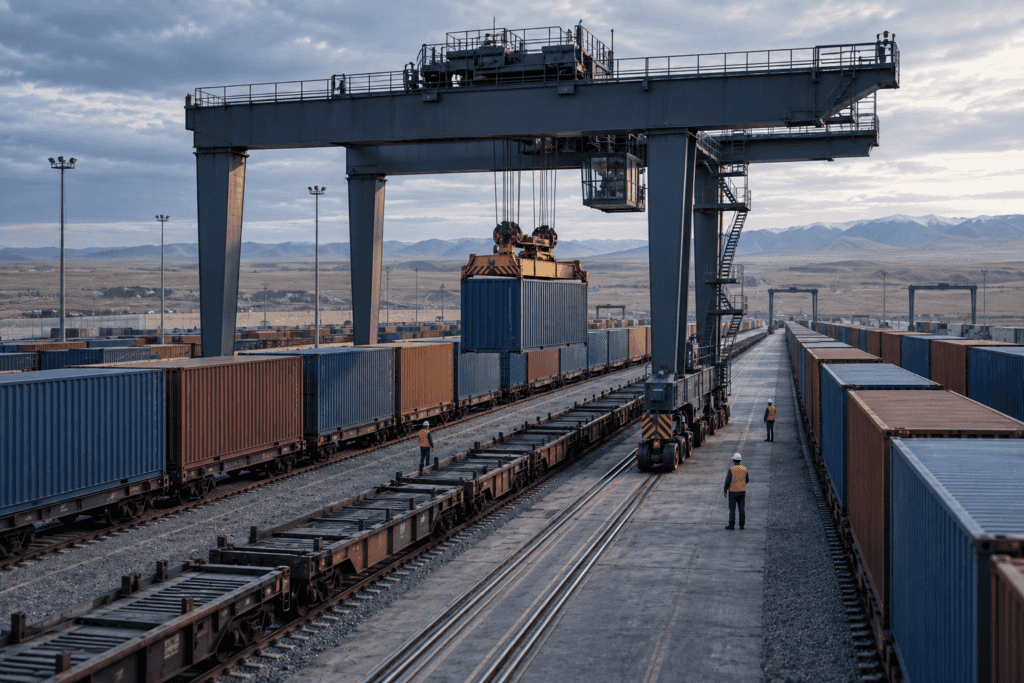
**The rail gauge changes at the border.** China runs standard gauge at 1,435 mm; the former Soviet network runs broad gauge at 1,520 mm. Every container is transhipped between railcars at the crossing. This is not a delay in itself, but it is a queue, and queue length at the border is the single biggest variable in your transit time.
**Customs treatment varies by country.** Kazakhstan and Kyrgyzstan are members of the Eurasian Economic Union, which operates as a customs union — goods cleared into one member can generally move to another without a further customs entry. Uzbekistan and Turkmenistan are not members and clear independently. This materially affects how you should structure a shipment serving more than one country.
Two rail crossings carry almost all China–Central Asia freight, and choosing between them is the most consequential routing decision on this lane.
| Crossing | China side | Kazakh side | Daily capacity | Character |
|---|---|---|---|---|
| Khorgos | Khorgos, Xinjiang | Altynkol | ~4,200 TEU | Largest and most modern. Congests October–December. |
| Dostyk | Alashankou, Xinjiang | Dostyk | ~2,400 TEU | Smaller but historically less congested. Useful relief in Q4. |
| Torugart | Torugart Pass | — (Kyrgyzstan) | Road only | Direct to Kyrgyzstan. Weather-sensitive, niche. |
Capacity figures per Xilink, 2026.
The practical consequence: Khorgos is the default and it is the right default for most of the year. But in the fourth quarter — when pre-Chinese New Year volume and European peak season collide — Khorgos congestion can add days that Dostyk would not.
A forwarder who books Khorgos automatically in November is not making a decision. Ask which crossing your booking is routed through, and ask why.
| Destination | Published transit from major Chinese origins |
|---|---|
| Almaty, Kazakhstan | ~13–17 days |
| Bishkek, Kyrgyzstan | ~15–19 days (commonly via Almaty with onward road) |
| Astana, Kazakhstan | ~16–20 days |
| Tashkent, Uzbekistan | ~17–21 days |
| Karaganda, Kazakhstan | ~18–22 days |
Published industry ranges, Xilink 2026. Treat as planning figures rather than commitments.
Add two to four days at origin for pre-carriage and export clearance, and two to five at destination for customs and final delivery, for a realistic door-to-door window.
What moves these figures: border queue length, which is seasonal; customs processing in the transit country; and winter conditions, which slow terminal handling across the whole corridor. Ask for current timings before building a schedule around any published figure, including these.
Published market figures for a 40ft container to Almaty have run in the region of USD 4,200 to 5,040 depending on the Chinese origin, with one industry source reporting that range in May 2026 and a seasonal swing of 15 to 25%, peaking in the fourth quarter.
Those numbers are useful for calibration and useless for budgeting. Rail rates move with corridor capacity, border congestion, fuel and the relative price of alternatives. Anyone quoting you a fixed figure from a published article is quoting something that has already changed.
What is stable is the structure. Your cost is built from: pre-carriage to the departure terminal, the rail freight itself, transhipment at the gauge change, customs handling in the transit territory, and final delivery. On shorter corridors like this one, the first and last legs are a larger proportion of the total than they would be on a China–Europe run — which is why the departure terminal you use matters more here than people expect.
Block train slot pooling — combining several shippers’ containers to book as a group — produces meaningful savings at four containers and above, according to published industry analysis.
If you are shipping regularly on this corridor, ask your forwarder whether they can pool your volume with other cargo on the same service. It is a larger lever than a rate negotiation on a single booking, and it is rarely offered unprompted.
Rail, in almost every case, and the reason is geography rather than economics.
There is no port. Sea freight to Central Asia means landing at a port outside the region — a Russian Far East terminal, a Black Sea port, or Bandar Abbas in Iran — and then moving cargo overland for a considerable distance. Each option adds a transhipment, a customs territory and days.
Sea plus road can occasionally win on very heavy, very low-value cargo where transit time genuinely does not matter and the tonnage makes rail rates punitive. That is a narrow case. For manufactured goods, machinery, consumer products, equipment and almost everything else, rail is faster, simpler and usually cheaper once the full door-to-door cost is counted.
Air freight exists for urgent cargo but the regional network is thin compared with the main Asian hubs, and rates reflect that.
A new rail corridor is under construction that will change the regional freight map when it opens.
The China–Kyrgyzstan–Uzbekistan railway — usually shortened to CKU — runs roughly 500 kilometres, of which around 300 are in Kyrgyzstan. It would connect western China to Uzbekistan directly through the mountains, rather than routing north through Kazakhstan as all current traffic does.
The projected effect is significant: reported estimates suggest it could cut freight distances by more than 1,000 kilometres and around seven days off transit compared with the northern route.
**Where it stands.** Construction is active. Kyrgyzstan completed drilling its first tunnel — the 209.6-metre Kosh Dobo North No. 2 — in September 2026, with 27 further tunnels, 43 bridges and 88 roadbed sections still in progress. **No completion date has been announced**, and mountain railways of this kind rarely finish early.
**What to plan around.** Nothing, yet. The engineering challenges are real: mountainous terrain makes operations expensive, limits train length and weight, and may require double traction on the gradients. Whether CKU becomes a genuine long-distance freight artery or settles into regional traffic will depend on how those constraints resolve and on border and onward capacity.
It is worth knowing about because it will eventually change routing options for Uzbekistan-bound cargo. It is not worth delaying a shipment for.
The standard export set applies — commercial invoice, packing list, contract and export declaration — with three regional additions worth knowing about.
**Certificate of origin.** More frequently required than on other lanes, and more frequently consequential, because preferential rates and import treatment often depend on it.
**EAC conformity marking.** Products entering the Eurasian Economic Union market may require EAC certification, which is a product compliance requirement rather than a shipping one. It has to be arranged before the goods travel, not at the border. If your buyer has not mentioned it and your product is in a regulated category, raise it early.
**Transit documentation.** Because the train crosses customs territories before reaching its destination, the paperwork must satisfy each of them. A discrepancy found in transit is expensive to fix — there is no equivalent of a port office to walk into.
This is the main argument for having declarations prepared by licensed declarants before departure rather than corrected en route.
The corridors serving Central Asia are physically the same network that serves Russia, and shipments frequently involve both.
Kazakhstan sits on the main route between China and Russia, and a Kazakh destination and a Russian one may share most of their journey. If your distribution covers both, that is worth structuring deliberately rather than as two separate arrangements — particularly given the EAEU customs treatment between member states.
We hold rail desks at Jiaozhou, Zhengzhou and Xi’an covering these corridors, and an office in Vladivostok. Send us the full picture of where cargo needs to reach and we will tell you how it should be structured.
Four questions that separate operators quickly on this lane.
**Which border crossing do you route through, and do you have a choice?** An operator with only one relationship will always tell you Khorgos. One with genuine options will discuss Dostyk in Q4.
**Which departure terminals can you offer?** Pre-carriage to the wrong terminal can add several days and meaningful cost on a corridor this length. More origination options is a real advantage here.
**Do you prepare the customs documentation yourself?** On a route crossing multiple customs territories, this matters more than it does on a port-to-port run.
**Can you pool my containers on a block train?** If they cannot, you are paying single-shipper rates on a corridor where pooling is standard practice.
Five things and we can come back with routing options and an all-in rate.
Origin — the supplier’s city, which determines the best departure terminal. Destination — full address, since distance from the arrival terminal shapes the cost. Commodity and HS code, so we can confirm what can be carried before quoting rather than after. Volume and weight, which determines full container against consolidated. And your target window, with a note on whether it is firm.
If your cargo is also heading to Russia or elsewhere in the EAEU, tell us that at the same time — it frequently changes how the whole movement should be structured.
Published industry figures put Almaty at roughly 13 to 17 days from major Chinese origins, Tashkent at 17 to 21, and Bishkek at 15 to 19. Add two to four days at origin and two to five at destination for a realistic door-to-door window.
Khorgos–Altynkol and Alashankou–Dostyk carry almost all rail freight. Khorgos is larger and more modern at around 4,200 TEU daily capacity but congests between October and December; Dostyk is smaller at around 2,400 TEU but historically less congested. Torugart Pass is a road-only route into Kyrgyzstan.
Rail, in almost all cases. The region is landlocked, so sea freight requires landing at a port outside Central Asia and moving cargo overland for a considerable distance, adding transhipments, customs territories and days. Sea plus road only competes on very heavy, very low-value cargo with no time pressure.
One industry source reported around USD 4,200 to 5,040 for a 40ft container to Almaty in May 2026, varying by Chinese origin, with a 15 to 25% seasonal swing peaking in the fourth quarter. Rail rates move with capacity and congestion, so treat any published figure as calibration rather than a budget.
Yes. Current traffic routes north through Kazakhstan, with Tashkent typically 17 to 21 days from major Chinese origins. Uzbekistan is not an EAEU member, so it clears customs independently of Kazakhstan.
The China–Kyrgyzstan–Uzbekistan railway, a corridor under construction running roughly 500 km through the mountains to connect western China directly to Uzbekistan. Estimates suggest it could cut freight distances by over 1,000 km and around seven days. Construction is active — Kyrgyzstan completed its first tunnel in September 2026 — but no completion date has been announced.
No. Kazakhstan and Kyrgyzstan are Eurasian Economic Union members operating as a customs union, so goods cleared into one member can generally move to another without a further entry. Uzbekistan and Turkmenistan are not members and clear independently. Structure shipments serving multiple countries accordingly.
The standard export set — commercial invoice, packing list, contract and export declaration — plus a certificate of origin, which is required more often on this lane than most. Products entering the EAEU market may also need EAC conformity certification, arranged before the goods travel rather than at the border.
Yes, and it is the largest cost lever on this corridor. Block train slot pooling produces meaningful savings from around four containers upward. Ask whether your forwarder can pool your volume with other cargo on the same service — it is rarely offered unprompted.
Tags:
Share: