
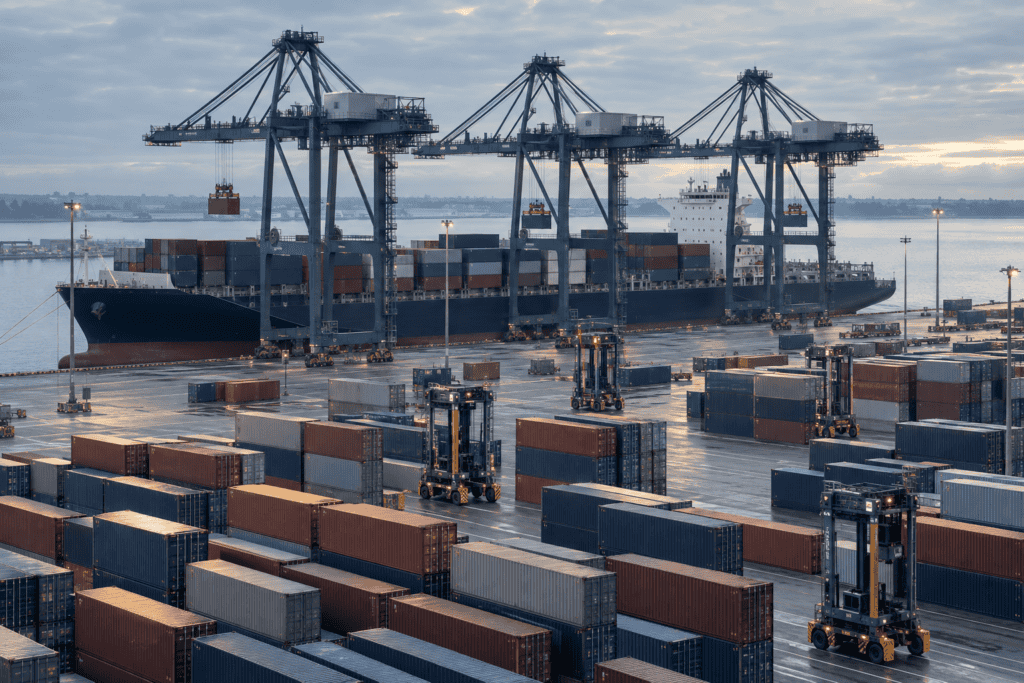
Qingdao moved 27.6 million TEU in the first ten months of 2025, making it China’s fourth-busiest container port and one of the ten busiest in the world. It is also the port most overseas buyers know least about, because the English-language coverage of Chinese shipping is dominated by Shanghai and Shenzhen.
This is a guide to what Qingdao is actually good at, how long cargo takes from here, what Shandong exports, and how to tell a forwarder genuinely based in the city from one with a name on a door. We are headquartered here, which shapes both what we know and what we would say — worth stating at the top.
Qingdao suits cargo originating in Shandong, northern China and the Yellow River basin, and it is strong on bulk commodities, machinery, tyres, chemicals, agricultural products and cold chain. It has direct services to Europe, North America and Southeast Asia, plus a China–Europe rail terminal at Jiaozhou. It is not the right port for cargo produced in the Pearl River Delta or the Yangtze delta — proximity beats port size almost every time.
Fourth in China and among the ten largest in the world.
| Port | TEU, Jan–Oct 2025 | Rank in China |
|---|---|---|
| Shanghai | 46.1 million | 1 |
| Ningbo-Zhoushan | 36.3 million | 2 |
| Qingdao | 27.6 million | 4 |
Source: Port Technology International, year-to-date through October 2025.
Scale on its own tells you little — a port can be enormous and still wrong for your cargo. What the figure does tell you is that carrier coverage is deep. Qingdao is served directly on all the main trades rather than as a feeder port, which means more sailings, more competitive rates and fewer transhipments than a smaller northern alternative.
For an exporter, the practical consequence of direct service is schedule reliability. Every transhipment is a place where a connection can be missed.
Historically, bulk. Qingdao built its reputation on crude oil, iron ore and coal, and it remains one of China’s principal bulk gateways — which matters more than it sounds, because the infrastructure built for bulk handling is the same infrastructure that makes heavy and oversized cargo straightforward here.
That profile has broadened considerably. The port now handles containerised consumer goods and cold chain at scale, and it has become a key hub for trade with RCEP member countries and the Shanghai Cooperation Organisation economies — which is why services to Southeast Asia, Russia and Central Asia are better from Qingdao than the port’s overall ranking would suggest.
Three practical strengths for an overseas buyer:
**Heavy and project cargo.** Bulk-handling infrastructure, heavy-lift capability and yard space that a purely container-focused port does not have.
**Cold chain.** Substantial reefer capacity and handling experience, serving Shandong’s agricultural and seafood exports.
**Northern and Central Asian connectivity.** Direct services plus rail links that make Qingdao a natural gateway for cargo heading overland rather than only by sea.
Qingdao suits cargo originating in Shandong, northern China and the Yellow River basin, and it is strong on bulk commodities, machinery, tyres, chemicals, agricultural products and cold chain. It has direct services to Europe, North America and Southeast Asia, plus a China–Europe rail terminal at Jiaozhou. It is not the right port for cargo produced in the Pearl River Delta or the Yangtze delta — proximity beats port size almost every time.
| Destination | Ocean transit (port to port) | Rail from Jiaozhou |
|---|---|---|
| North Europe — Hamburg, Rotterdam | ~30–35 days | ~18–22 days |
| Mediterranean | ~28–32 days | — |
| US West Coast | ~14–18 days | — |
| US East Coast | ~30–35 days | — |
| Southeast Asia | ~7–14 days | — |
| Moscow | ~35–40 days via sea | ~15–18 days |
Treat these as planning ranges. Actual transit depends on whether the service is direct or transhipped, the specific port pair, and seasonal congestion. Ask for current schedules before building a date around any published figure, including these.
Add two to four days at origin for pickup, stuffing and export clearance, and two to five at destination for customs and delivery, to get a realistic door-to-door window.
The honest answer is almost always: whichever is closest to your supplier.
Inland haulage in China is expensive and slow relative to the ocean leg, and a container trucked 900 km to a marginally better port has usually lost more than it gained. The port comparison only matters once proximity is roughly equal.
| Qingdao | Shanghai | Ningbo-Zhoushan | |
|---|---|---|---|
| Natural catchment | Shandong, northern China, Yellow River basin | Yangtze delta, central China | Zhejiang, Yangtze delta |
| Scale | 27.6m TEU | 46.1m TEU | 36.3m TEU |
| Strongest on | Bulk, machinery, tyres, chemicals, cold chain, project cargo | Everything — widest service coverage | Manufactured goods, high container volume |
| Congestion risk | Lower | Higher at peak | Moderate |
| Rail to Europe | Jiaozhou terminal | Available | Available |
Where Qingdao genuinely wins beyond proximity: **congestion**. Shanghai is the busiest container port in the world and behaves like it during peak season and after weather disruption. Qingdao’s lower relative volume means less queueing, which on a tight schedule can outweigh a difference in sailing frequency.
Where Shanghai wins: **service breadth**. If your destination is unusual, Shanghai will have a direct service when Qingdao may require transhipment.
Shandong is one of China’s largest manufacturing provinces and its export profile is heavier and more industrial than the consumer-goods picture most buyers associate with China.
The main sectors: machinery and equipment, tyres and rubber products, chemicals, agricultural products and processed food, seafood, textiles, home appliances, auto components, and steel and metal products.
Qingdao itself is a significant industrial centre — home appliances, shipbuilding and offshore engineering, marine biomedicine, and brewing all have a substantial presence, and the city has been pushing into marine technology and aquaculture.
For a buyer, the practical implication is sourcing geography. If you are buying tyres, industrial machinery, chemicals, agricultural products or appliances, there is a reasonable chance your supplier is in Shandong — and shipping from Qingdao rather than trucking to Shanghai will be both cheaper and faster.
Jiaozhou, just outside Qingdao, is a China–Europe block train origination point — and it is one almost no forwarder will quote you, because almost none have a desk there.
The well-known departure terminals are Xi’an, Chengdu, Zhengzhou and Yiwu. They are well-known because they are where most operators have presence. For cargo originating in Shandong, routing through them means trucking several hundred kilometres inland before the train even starts, which adds cost and days to a mode chosen for speed.
Departing from Jiaozhou removes that. For a Shandong exporter with cargo too urgent for a vessel and too heavy to fly, it is frequently the best option available and the one nobody put on the table.
We run a rail desk there. Ask about it specifically — a forwarder without local presence will quote you Xi’an and not mention that a closer option exists.
Two facilities worth knowing about if you are buying from multiple Shandong suppliers.
**CFS consolidation.** Rather than each supplier shipping LCL separately, they deliver to a container freight station in Qingdao where the cargo is checked, counted and stuffed into one container under your name. You get FCL economics and FCL transit times on a combined volume no single supplier could justify, and the goods are inspected before the container is sealed rather than after it arrives.
For a buyer running 4 CBM each from five Shandong factories, this is almost always the right structure, and it is rarely offered unprompted.
**Bonded storage.** Qingdao has bonded warehousing available for importers holding stock with duty deferred, for re-export operations, and for staging inventory whose final destination is not yet decided. Useful if you are using China as a regional distribution point rather than only as an origin.
Search the term and you will get global forwarders with a Qingdao office alongside companies actually headquartered here. Both are legitimate. They are not the same, and five questions expose the difference quickly.
**Can I visit your warehouse?**
The most useful question on this list, and the one that produces the most revealing answers. A forwarder operating their own CFS in Qingdao will say yes and offer a date. One subletting space or working through a partner will find reasons. If you are consolidating cargo from multiple suppliers, you should see where it is being handled at least once.
**Who files my customs declarations — you, or a subcontractor?**
Many forwarders subcontract clearance. If they do, your cargo inherits the subcontractor’s compliance profile, and a query on your entry goes through a third party. Ask for the customs credit tier of whoever actually files.
**Do you have staff at the rail terminal, or do you route everything through Xi’an?**
A local operator can offer Jiaozhou. A networked one usually cannot, and may not mention the option exists.
**What happens if there is a problem at 2am on a Saturday?**
Not a trick question. Ask who you would actually be speaking to, and whether they are in Qingdao or a regional hub several time zones away.
**How long have you been here?**
Local customs relationships, port knowledge and the ability to resolve a query in person rather than by email are all functions of time in one place.
For reference: E-AndEx has been headquartered in Qingdao since 2002 and is listed on China’s NEEQ exchange under stock code 838031. Our CFS, bonded facility, rail desk at Jiaozhou and AEO-Advanced customs brokerage are all in this city, staffed by our own people.
Three situations where we would route you elsewhere.
**Your supplier is in the south.** If the factory is in Guangdong, Fujian or anywhere in the Pearl River Delta, ship from Shenzhen, Guangzhou or Hong Kong. Trucking 1,800 km north to use Qingdao makes no sense at any rate difference.
**Your supplier is in the Yangtze delta.** Jiangsu, Zhejiang and Shanghai cargo belongs in Shanghai or Ningbo. The inland haulage saving is immediate and the port difference is marginal.
**Your destination has no direct service.** For unusual destinations Shanghai’s service breadth may mean a direct sailing where Qingdao requires transhipment. One transhipment can cost more days than the entire inland leg you saved.
We are a Qingdao company and we will still book your cargo through Shanghai or Shenzhen when that is the right answer — our offices in both cities exist for exactly that reason. A forwarder who recommends their home port regardless of where your cargo is produced is optimising for themselves.
Send us four things and we will come back with a routing plan and an all-in rate, usually the same working day.
Your supplier’s city — which determines whether Qingdao is even the right port. Volume and weight. Destination, as a full address rather than a port. And your target date, with a note on whether it is firm.
If your cargo is produced in Shandong, we will quote sea, rail from Jiaozhou and air, and tell you which the numbers favour. If it is produced 1,500 km away, we will tell you that too.
Qingdao handled 27.6 million TEU in the first ten months of 2025, making it China’s fourth-busiest container port behind Shanghai (46.1 million) and Ningbo-Zhoushan (36.3 million), and one of the ten busiest seaports in the world.
Historically bulk cargo — crude oil, iron ore and coal — and it remains a principal bulk gateway. It has expanded into containerised consumer goods and cold chain, and serves as a key hub for RCEP and Shanghai Cooperation Organisation trade. The bulk infrastructure also makes it strong for heavy and project cargo.
Roughly 30 to 35 days port to port to North European base ports, or 18 to 22 days by rail from the Jiaozhou terminal. Add two to four days at origin and two to five at destination for a realistic door-to-door window.
Yes, if your cargo originates in Shandong or northern China. It has deep carrier coverage, lower congestion than Shanghai, strong bulk and project cargo capability, and a China–Europe rail terminal. If your supplier is in the south or the Yangtze delta, a closer port will beat it.
Shanghai is larger with wider service coverage and serves the Yangtze delta. Qingdao serves Shandong and northern China, carries less congestion risk, and is stronger on bulk and project cargo. The deciding factor is almost always which is closer to your supplier — inland haulage in China outweighs most port-level differences.
Both global forwarders with local offices and companies headquartered in the city. The practical test is whether they operate their own CFS and file their own customs declarations, or work through partners — ask to visit the warehouse and ask who files the entries.
With a forwarder operating their own facility, yes, and you should if you are consolidating cargo from multiple suppliers. A company subletting space or working through a partner will usually find reasons why a visit is difficult, which is itself an answer.
Machinery and equipment, tyres and rubber, chemicals, agricultural products and processed food, seafood, textiles, home appliances, auto components, and steel and metal products. Qingdao itself is strong in home appliances, shipbuilding, offshore engineering and marine technology.
Tags:
Share: