
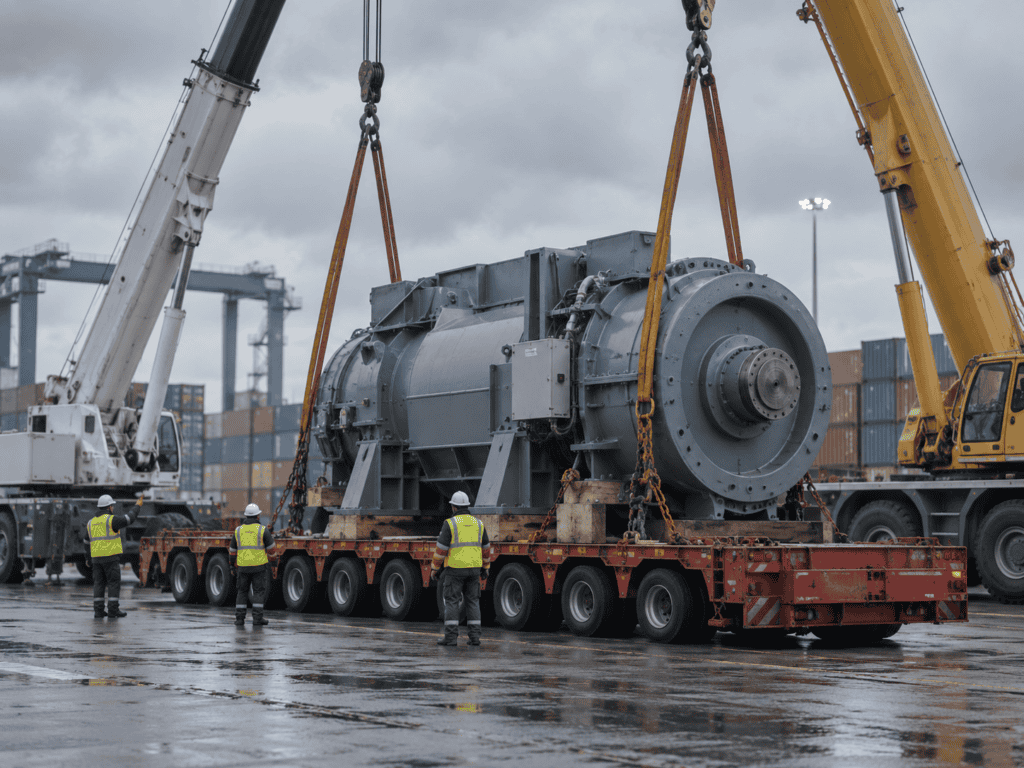
Project cargo is where the standard answers stop working. The unit will not fit in a container, the route has a bridge that will not clear it, the crane at the destination port is rated below what you need, and the permit application takes longer than the sailing.
Each of those is solvable. None of them is solvable late. This article covers how to choose between flat rack, open top, breakbulk and RoRo, what Chinese oversized-load permits actually involve, and why the route survey has to come before the quotation rather than after it.
If your cargo exceeds container internal dimensions but still fits within a terminal’s normal handling envelope, a flat rack or open top is usually cheapest. Beyond that, or where the piece cannot be secured to a rack, you are into breakbulk or charter. The decision is driven by dimensions, weight distribution and destination port capability — not by cost alone.
Out-of-gauge — OOG — is cargo that exceeds the internal dimensions of a standard shipping container in at least one direction. It still travels on a container vessel, but on specialised equipment and with the overhang accounted for in the stowage plan.
The distinction that matters operationally is between out-of-gauge and breakbulk. OOG cargo is containerised — loaded onto a flat rack or into an open top, and handled by container terminal equipment. Breakbulk cargo is not containerised at all: it is lifted directly into a vessel’s hold or onto its deck, and it needs a vessel and a terminal equipped for that.
Crossing from one to the other changes your cost base, your available sailings and your destination port options all at once. It is the single most consequential decision in a project shipment, which is why it should be made on a survey rather than an assumption.
Both handle cargo that will not fit a standard container. They solve different problems.
An **open top** is a standard container with a removable tarpaulin roof instead of a fixed one. The walls and floor are intact. It suits cargo that fits within the container’s length and width but is too tall, and that needs to be loaded from above by crane rather than pushed in through the doors. The cargo is enclosed on four sides, which offers some protection and some securing points.
A **flat rack** is a base with two end walls and no sides or roof. It suits cargo that is too wide, or too heavy to be supported by a standard container floor, or shaped such that it has to be lifted on and lashed down rather than placed inside anything. Some flat racks have collapsible end walls, which lets them be stacked when empty.
| Open top | Flat rack | |
|---|---|---|
| Over-height cargo | ✓ within container width | ✓ |
| Over-width cargo | ✗ | ✓ |
| Heavy concentrated loads | Limited | ✓ |
| Loading method | Crane from above | Crane from above or side |
| Weather protection | Tarpaulin, partial | None |
| Typical use | Tall machinery, cargo needing four-sided containment | Wide or heavy units, awkward shapes |
Somewhere between roughly 30 and 50 tonnes, and the only number that matters is the one on the specific unit your carrier provides.
Published figures vary widely between operators and between equipment series. One major line’s specification puts a 20ft flat rack at around 42 tonnes and a 40ft at around 49. Another source lists the 20ft at around 45 tonnes and the 40ft at around 40.
That second pairing looks like an error and is not. A 20ft flat rack frequently carries more concentrated weight than a 40ft, because the 40ft frame weighs more itself and spreads its rating over a longer span. If your cargo is heavy and compact, the shorter unit may be the stronger one.
So the answer to “what is the maximum weight” is: ask for the equipment specification of the line and series being offered, before you design the lashing. We do this as a matter of course, and it occasionally changes which carrier we recommend.
Three other constraints bite before the payload rating does more often than people expect.
**Point loading.** A rating assumes weight distributed across the deck. A machine sitting on four small feet concentrates it, and the deck may need load-spreading timbers or a steel frame regardless of whether the total is within rating.
**Centre of gravity.** Off-centre or high-set weight affects both the lift and the stowage plan, and may rule out equipment that the raw numbers permit.
**Destination handling.** A 45-tonne unit is irrelevant if the destination terminal’s crane is rated at 35. We check both ends before quoting.
Four triggers, any one of which usually settles it.
**The piece exceeds flat rack capacity** in weight or dimension. Once you are past what the largest available rack will take, containerisation is simply not an option.
**The overhang is too great for terminal handling.** Container terminals have limits on how far cargo can protrude before it interferes with adjacent stowage and crane operation. A moderately over-width piece is fine; a dramatically over-width one is not.
**The cargo cannot be lashed to a rack safely.** Some shapes have no usable securing points, or distribute load in a way that no lashing plan resolves.
**The economics flip.** Beyond a certain size, the number of flat racks required — and the slots they block around them — costs more than booking breakbulk space.
That last one surprises people. An out-of-gauge unit does not only occupy its own flat rack; it renders the slots above and beside it unusable, and carriers charge for those. On a large piece, the effective cost can be several times the visible rack rate. Ask for the quote including slot blockage before comparing it to a breakbulk alternative.
Roll-on/roll-off — cargo driven or towed onto the vessel on its own wheels or on a trailer, rather than lifted.
It suits anything self-propelled or wheeled: construction machinery, agricultural equipment, trucks, buses, cranes on their own chassis. It removes the lift entirely, which removes the associated risk and frequently the cost.
The constraints are ramp capacity, deck height clearance and the availability of RoRo services on your lane, which are considerably less frequent than container sailings. Tracked equipment can usually be moved onto a RoRo vessel but may need boards or a trailer to avoid damaging the deck.
If your cargo has wheels, ask about RoRo before you ask about flat racks. It is routinely overlooked and it is often the cheapest and safest answer.
Inland movement of an over-dimension or overweight load in China requires a road transport permit from the traffic management authority of every province the route crosses.
The permit specifies the approved route, the permitted travel times — often restricted to night hours — and any escort requirement. Provinces issue independently, so a route crossing three provinces means three applications, each assessed against that province’s own infrastructure and rules.
Alongside the road permits you may need port entry approval for the vehicle combination, and for the lift itself, a crane operation plan filed with the terminal.
Three to six weeks is a realistic planning range for a multi-province route, and it is usually the longest single item in a project schedule.
The variables: how many provinces, how far outside standard dimensions the load sits, whether the proposed route includes structures needing individual assessment, and whether any structural survey or temporary modification is required — occasionally a bridge must be assessed or street furniture temporarily removed, which adds weeks and cost.
This is why the route survey comes first. The permit application requires a defined route, and the route cannot be defined until someone has established that it physically works. Applying before the survey wastes the application.
A route survey checks bridge and tunnel clearances, road weight limits and axle loading restrictions, turning radii at every junction, overhead obstructions including power lines, and crane capacity at both the load port and the destination.
It takes one to two weeks and it determines everything downstream: which equipment, which ports, which route, which permits, and whether the shipment is feasible at all in the form proposed. Occasionally the survey’s conclusion is that the cargo must be dismantled into two pieces — expensive news, but dramatically cheaper before fabrication is complete than after it arrives at a quay.
A quotation issued without a survey is an estimate of a shipment nobody has confirmed is possible.
There is no rate card, and any forwarder quoting from dimensions alone is guessing at something you will pay for later.
The cost is built from components that vary enormously by shipment: ocean freight including slot blockage for OOG, or breakbulk space; specialised equipment hire — flat racks, modular trailers, load-spreading; cranes at both ends, priced by capacity and duration; lashing and securing materials, engineered per unit; permits and any escort requirement; the route survey itself; supervision; and customs clearance.
What moves the total most is rarely the ocean leg. It is the inland movement, the permits and the lifts — which is precisely where a survey-based quote differs from an estimate.
The most useful thing you can do to control cost is engage early. A piece designed with lifting points in sensible positions, dimensions a few centimetres under a permit threshold, or a split line that allows two-part shipment, costs substantially less to move than the same equipment designed without reference to how it will travel. We have had those conversations at the design stage and they have saved real money.
| Shipment type | Lead time |
|---|---|
| Moderate OOG on flat rack, single province | 4–6 weeks |
| OOG with multi-province inland movement | 8–12 weeks |
| Breakbulk or charter with heavy lift | 10–16 weeks |
| Complete plant relocation | 6 months or more |
Working backwards from a required in-position date: route survey one to two weeks, permits three to six weeks (often in parallel with other work, but not with the survey), equipment and vessel booking two to four weeks, and the transit itself.
If your date is already tight, say so at the first conversation. Sometimes the constraint is solvable — a different port, a different corridor, a split shipment — and sometimes it genuinely is not. You should hear which one it is immediately, not after four weeks of planning.
It depends on the contract and the incoterm, and for project cargo it is worth settling explicitly before the equipment moves rather than discovering the position afterwards.
The general shape: a freight forwarder carries standard forwarder liability, which is typically limited by weight and is rarely adequate for a high-value single unit. The lifting contractor carries its own liability for the lift operation. Marine cargo insurance covers the cargo itself, but standard policies do not always extend to lifting operations, which are frequently excluded or separately rated.
For a valuable single piece, the practical answer is project-specific marine cargo insurance covering the full origin-to-final-position scope **including the lifts**, arranged before the cargo moves. We will tell you what the policy needs to specify and can arrange it as part of the scope.
The question to ask any forwarder: “what is your liability limit on this shipment, in currency, and what is excluded?” A specific answer is a good sign. A reassuring but vague one is not.
A factory move is not a large shipment. It is a sequencing exercise that happens to involve freight.
The governing constraint is that equipment must arrive in the order the new site can install it, which is rarely the order it is convenient to dismantle. Critical machinery is often the last out and the first in — load it first and the new site sits idle waiting for the one machine everything else depends on.
Done properly it involves 3D scan modelling of both sites before anything is disconnected, a dismantling and re-erection sequence agreed with the production team, hydraulic jacking for large assemblies that cannot be craned, and a movement schedule built backwards from the restart date.
Start six months out. Relocations that go wrong almost always went wrong in the planning, not the transport.
Four things, and we can tell you whether it is feasible before anyone commits.
**Dimensions and weight of each piece**, as it will actually ship — including any cradle, frame or packaging.
**Lifting point positions**, or the drawing that shows them. If they have not been decided yet, that is a useful conversation to have now rather than later.
**Both end addresses** — the fabrication site and the final position, not the ports. The inland legs are where feasibility is usually decided.
**The required in-position date**, and whether it is firm.
We will come back with a view on the equipment, the likely corridor, the permit timeline and whether the date is achievable. If the route will not carry it, you will hear that first rather than last.
Cargo that exceeds the internal dimensions of a standard container in at least one direction but still travels on a container vessel, using specialised equipment such as a flat rack or open top with the overhang built into the stowage plan.
An open top is a standard container with a removable tarpaulin roof — it suits over-height cargo that fits the container footprint and needs crane loading from above. A flat rack has no sides or roof and suits over-width cargo, heavy concentrated loads, or shapes that must be lashed down rather than placed inside anything.
Roughly 30 to 50 tonnes depending on the operator and equipment series. Published figures vary widely, and a 20ft flat rack often carries more concentrated weight than a 40ft because the longer frame weighs more and spreads its rating further. Always ask for the equipment specification of the specific line and series being offered.
When the piece exceeds flat rack capacity, when the overhang is too great for container terminal handling, when the cargo cannot be safely lashed to a rack, or when the number of racks plus blocked adjacent slots costs more than breakbulk space.
Roll-on/roll-off — cargo driven or towed aboard on its own wheels or on a trailer rather than lifted. It suits construction machinery, agricultural equipment and anything self-propelled, and removes the lift risk entirely. Constraints are ramp capacity, deck height and service frequency on your lane.
There is no rate card. Cost is built from ocean freight including slot blockage, specialised equipment, cranes at both ends, engineered lashing, permits and escorts, the route survey and supervision. The inland movement and lifts usually move the total more than the ocean leg does.
A road transport permit from the traffic authority of every province the route crosses, specifying the approved route, permitted travel times and any escort requirement. Port entry approval for the vehicle combination and a crane operation plan filed with the terminal may also be required.
Three to six weeks for a multi-province route, and usually the longest single item in the schedule. It depends on how many provinces, how far outside standard dimensions the load sits, and whether any structure on the route needs individual assessment.
Four to six weeks for moderate out-of-gauge on a single province route, eight to twelve for multi-province inland movement, ten to sixteen for breakbulk or charter with heavy lift, and six months or more for a complete plant relocation.
It depends on the contract and incoterm. Forwarder liability is typically limited by weight and rarely adequate for a high-value single unit, and standard marine cargo policies do not always cover lifting operations. For valuable pieces, arrange project-specific cover for the full origin-to-final-position scope including the lifts, before the cargo moves.
Tags:
Share: