
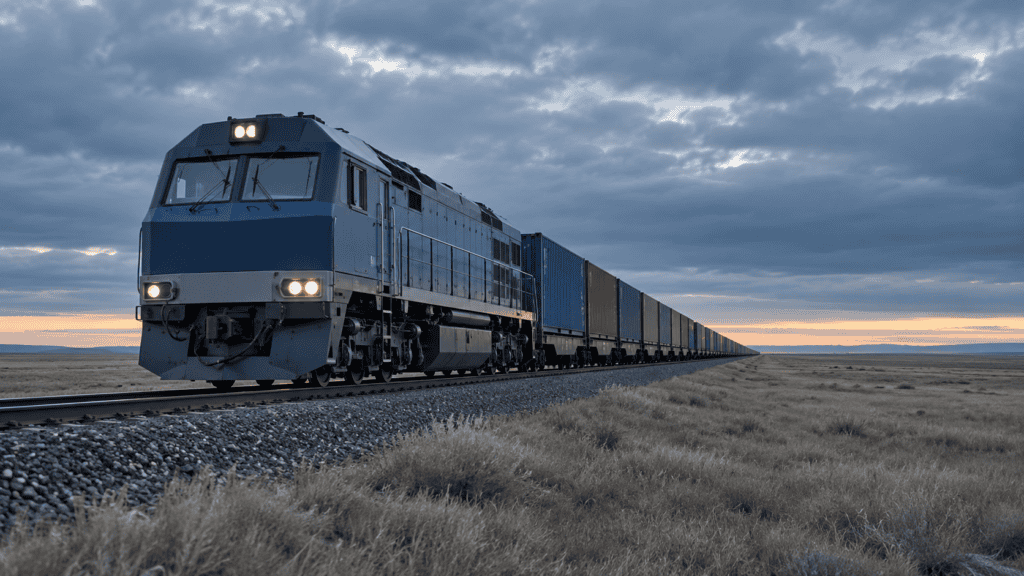
Rail sits between ocean and air on almost every measure — roughly half the sea transit time at a small fraction of the air rate. For cargo heading to Europe, Russia or Central Asia, that middle ground is often exactly right, and over the last decade it has become the default for goods too time-sensitive for a vessel and too heavy to justify a flight.
It is also the mode where the most planning goes wrong, because a rail schedule looks simpler on paper than it behaves in practice. This article covers what the corridors actually are, what moves the transit time, what the arithmetic looks like against sea and air — and the situations where the honest answer is that rail is not your best option.
China–Europe rail takes roughly 16 to 22 days station to station on the main corridors, against 30 to 45 days by sea and 2 to 5 by air. Cost sits between the two, typically several times an ocean rate and a small fraction of an air rate. It suits cargo that is too urgent for a vessel but too heavy or too routine to fly.
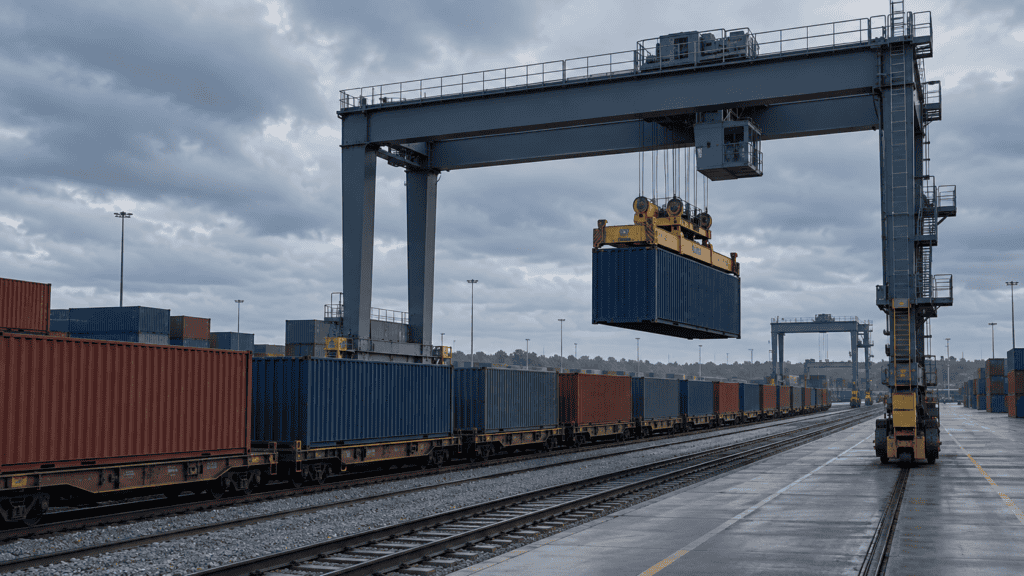
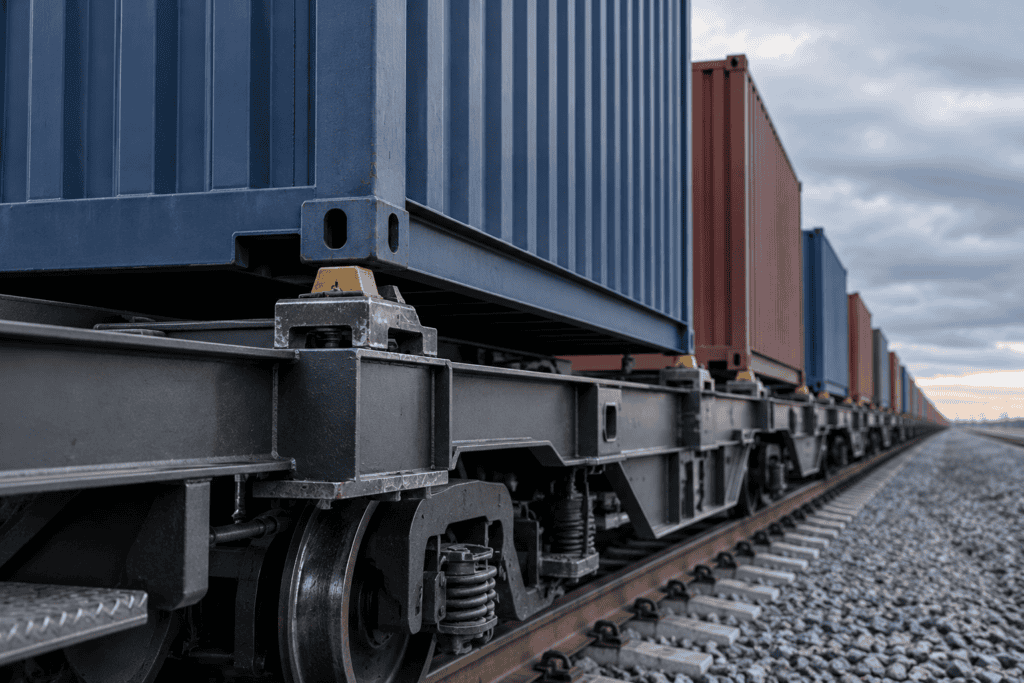
China Railway Express — often written as China–Europe Railway Express, and in Chinese as 中欧班列 — is the umbrella name for the scheduled block train services running between Chinese inland terminals and European destinations.
A block train is a full train travelling as one unit from origin to destination rather than being broken up and re-marshalled along the way. That is what makes the transit times possible. You book container slots on these scheduled services in much the same way you book space on a vessel.
The important practical difference from ocean freight is that departures are fixed and infrequent rather than continuous. A given corridor may run several times a week, not several times a day, which means your booking decision is really a choice between specific departure dates.
Three main corridors, distinguished by which border they cross.
| Corridor | Border crossing | Goes to |
|---|---|---|
| Western | Alashankou or Khorgos (Xinjiang) → Kazakhstan | Poland, Germany, Netherlands, Western Europe. The highest-volume route. |
| Middle | Erenhot (Inner Mongolia) → Mongolia | Russia and onward to Eastern Europe |
| Eastern | Manzhouli (Inner Mongolia) → Russia | Russia, the Baltics, Eastern Europe |
Most Europe-bound cargo takes the western corridor through Kazakhstan, then crosses Belarus into Poland. The overwhelming majority of that traffic passes through a single EU gateway — Brest on the Belarusian side, Małaszewicze on the Polish side — which is the busiest and most congestion-prone point on the whole route. When you read about China–Europe rail delays, this is usually where they originate.
Departure terminals matter as much as corridors. The best-known are Xi’an, Chengdu, Zhengzhou and Yiwu. We also run a desk at Jiaozhou, which serves Shandong and the Qingdao industrial base — a departure point most forwarders will not quote you because they have no presence there, and one that removes several days of pre-carriage for cargo originating in the region.
Station to station on the main corridors, 16 to 22 days is a realistic planning range. Door to door, add two to four days at origin for pre-carriage and export clearance, and two to five at destination for customs and final delivery.
| Route | Indicative station-to-station transit |
|---|---|
| Xi’an → Duisburg | ~16–20 days |
| Zhengzhou → Hamburg | ~18–22 days |
| Xi’an → Warsaw | ~14–18 days |
| Jiaozhou → Moscow | ~15–18 days |
| China → Almaty, Kazakhstan | ~8–12 days |
| China → Tashkent, Uzbekistan | ~12–16 days |
This is the part of rail freight that most guides mention in passing and none actually explain, and it is the single biggest structural difference between rail and every other mode.
Railways do not all use the same track width. China runs standard gauge at 1,435 mm. The former Soviet network — Kazakhstan, Russia, Belarus — runs broad gauge at 1,520 mm. The European Union is back to 1,435 mm.
A train cannot simply roll across that boundary. So on a China–Europe journey your container is transhipped twice: once from Chinese standard-gauge railcars onto broad-gauge railcars at the Kazakh or Russian border, and again from broad gauge back onto standard gauge at the EU frontier.
Three practical consequences.
Every transhipment is a handling event, and handling events are where damage happens. Rail transhipment is mechanised and generally careful, but cargo that is poorly secured inside the container will find out about it. Lashing matters more on rail than on a vessel that is loaded and unloaded once.
Every transhipment is also a queue. Each border has finite crane capacity, and when volume exceeds it, containers wait. This is the mechanism behind almost every rail delay you will read about — not slow trains, but full yards.
And every border is a customs territory. Documentation that satisfies one authority must satisfy the next. A discrepancy found in Kazakhstan costs days, not hours, and it cannot be fixed remotely with the speed you would manage at a seaport. This is why we prepare rail documentation through our own licensed declarants before departure rather than correcting it in transit.
Published ranges for a 40ft container on the main China–Europe corridors have run anywhere from roughly US$5,000 to US$9,000 in recent years, and LCL rail is commonly quoted per kilogram rather than per cubic metre.
Those numbers are close to useless as planning figures, and any article presenting them as fixed is misleading you. Rail rates move with capacity, corridor congestion, fuel, and the relative price of ocean freight — when sea rates spike, rail demand and rail pricing follow within weeks.
What is stable is the relationship between the modes.
| Mode | Transit (door to door) | Relative cost | Priced on |
|---|---|---|---|
| Sea | 35–50 days | Baseline | Container, or CBM/tonne for LCL |
| Rail | 20–30 days | Typically 2–4× sea | Container, or per kg for LCL |
| Air | 5–9 days | Typically 8–15× sea | Chargeable weight |
No. Rail is more expensive than sea on essentially every lane, and any quote suggesting otherwise deserves a second look at what it excludes.
The question worth asking is different: is the time saving worth the difference? Rail cuts roughly two weeks off an ocean transit. For most cargo that is not worth paying several times the rate. For some it clearly is.
It is worth paying for when you are holding inventory you cannot afford to have at sea for six weeks, when a seasonal window closes before a vessel would arrive, when ocean capacity has evaporated in peak season, or when your product cycles fast enough that two weeks of stock materially affects what you can sell.
Substantially, yes — typically a small fraction of an air rate for the same cargo.
Rail is also priced on container space rather than volumetric weight, which matters enormously for bulky goods. Cargo that is light relative to its size gets punished hard by air freight’s volumetric formula and not at all by rail. If you are shipping something bulky by air because the deadline seemed to require it, rail is frequently the option nobody put in front of you.\
Yes, and it is one of the least-known options in China–Europe logistics.
LCL rail works the same way as LCL sea — your cargo is consolidated with other consignments into a container at origin, and deconsolidated at destination. The difference is that you get a rail transit time on a part-container shipment, which for a 6 CBM consignment that cannot wait six weeks is often the only sensible answer.
It is usually priced per kilogram rather than per cubic metre, so density affects your cost differently than it would on LCL sea. Send us the weight and volume and we will price both so you can see which way your cargo falls.
The consolidation window is the main variable. Your cargo waits at the origin terminal until the container is full enough to load, and on a thin corridor that can be several days. Ask what the realistic window is on your specific route before committing to a date — a good forwarder will tell you honestly, and a bad one will quote you the best case.
Deconsolidation at destination adds a further two to four days after arrival. Build both into your planning rather than working from station-to-station transit alone.
Reliable, yes. Unaffected, no — and no other guide on this topic seems willing to say so.
The corridors cross Kazakhstan, Siberia and Mongolia, where winter temperatures routinely reach −30°C and can go lower. Four things change between roughly November and March.
Terminal handling slows. Crane operations, transhipment and yard movements all take longer in snow and ice, which lengthens the queue at exactly the borders that are already the bottleneck.
Some cargo becomes unsuitable. Liquids can freeze and burst their packaging. Certain adhesives, coatings, batteries and electronics have low-temperature limits that a standard dry container will not protect them from. A container is not insulated — internal temperature tracks ambient within a few degrees.
Temperature-controlled options exist but need arranging in advance. If your cargo has a genuine cold limit, tell us at quotation rather than at booking.
And demand peaks. The run-up to Chinese New Year concentrates enormous volume into a short window, which collides with the slowest handling conditions of the year. Slots tighten and transit times stretch simultaneously.
None of this makes winter rail a bad decision. It makes it a decision that needs three or four weeks more lead time than the same shipment in June.
More than most shippers expect, and the restrictions are stricter than the equivalent by sea.
Most dangerous goods classes are restricted or prohibited on the China–Europe corridors, and the permitted list varies by operator, by corridor and by transit country. Cargo that moves routinely in a sea container may be refused on rail.
Lithium batteries sit in a grey area that changes — some configurations move, others do not, and the answer depends on the specific corridor and operator.
Temperature-sensitive cargo needs the seasonal assessment described above rather than a yes or no.
High-value cargo is accepted but worth insuring specifically, given the number of handling events and customs territories involved.
Out-of-gauge cargo is limited by the loading gauge of the tightest tunnel on the route, which is considerably less generous than what a vessel will accept.
Send us the commodity and HS code before you plan around rail. We would rather tell you it will not work at quotation stage than have you discover it at the terminal.
Four situations where we will tell you to use something else.
**Your deadline is inside two weeks.** Door to door, rail is a 20 to 30 day proposition. If you need it sooner, that is an air freight question, and no amount of corridor optimisation closes the gap.
**Your cargo is cheap and bulky with no deadline pressure.** If two extra weeks at sea costs you nothing meaningful, paying several times the ocean rate to avoid them is simply expensive. Rail earns its premium on inventory value and time sensitivity; without those, it does not.
**Your destination is far from a rail terminal.** Rail is only competitive to the terminal. A destination requiring 800 km of onward trucking can erase the transit advantage and much of the cost logic at once. Always compare door to door, never station to station.
**Your cargo is restricted, or the season is against you.** If the commodity sits in a restricted class, or it is January and your goods have a low-temperature limit, forcing rail creates risk that the saved fortnight does not justify.
We run three rail desks and we still quote ocean or air on a large proportion of the enquiries that come to us asking about rail. A forwarder who only ever recommends the service you asked about is not advising you.
| Situation | Booking lead time |
|---|---|
| Standard corridor, normal season | 2–3 weeks |
| Peak season (Sept–Nov) | 3–4 weeks |
| Before Chinese New Year | 4–6 weeks |
| Winter, temperature-sensitive cargo | 4–6 weeks |
| LCL rail | 2–3 weeks, plus an unpredictable consolidation window |
Rail books further ahead than ocean because departures are scheduled rather than continuous. Missing a slot on a corridor running twice weekly means waiting three or four days for the next one, not a few hours.
If your date is fixed, book early. If it is flexible, tell us the window and we will find the best departure inside it — flexibility of even two or three days frequently improves both price and certainty.
Seven things, and the first quote will be one you can decide on.
The origin — factory address or city, not just the province. The destination — full delivery address, because the distance from the arrival terminal changes the answer. Commodity description and HS code, so we can check corridor restrictions before quoting rather than after. Volume in CBM and gross weight in kilograms, which determines FCL against LCL rail. Whether the cargo has any temperature limit. Your target arrival window, and whether it is firm. And whether you want us to price ocean and air alongside, which we would recommend.
We will come back with the realistic corridor options, the next two or three departure dates, an all-in rate, and an honest view on whether rail is the right call for this particular shipment.
Roughly 16 to 22 days station to station on the main corridors, or 20 to 30 days door to door once pre-carriage, clearance and final delivery are included. Compare that with 35 to 50 days by sea and 5 to 9 by air.
No — rail typically costs two to four times an equivalent ocean rate. The question is whether roughly two weeks of saved transit is worth that difference for your cargo, which depends on inventory value and deadline pressure.
Substantially, usually a small fraction of an air rate. Rail is also priced on container space rather than volumetric weight, which makes it particularly attractive for bulky cargo that air freight penalises.
Three main corridors. The western route crosses at Alashankou or Khorgos into Kazakhstan and carries most Europe-bound volume. The middle route crosses at Erenhot through Mongolia. The eastern route crosses at Manzhouli into Russia. Most western-corridor traffic enters the EU at Brest–Małaszewicze.
The umbrella name for scheduled block train services between Chinese inland terminals and European destinations. A block train travels as one unit rather than being re-marshalled en route, which is what makes the transit times achievable.
Yes. Cargo is consolidated into a container at origin and deconsolidated at destination, so a part-container shipment still gets a rail transit time. It is usually priced per kilogram rather than per CBM, and the consolidation window is the main variable to ask about.
Most dangerous goods classes are restricted or prohibited, with the permitted list varying by operator and transit country. Lithium batteries sit in a shifting grey area, temperature-sensitive cargo needs seasonal assessment, and out-of-gauge cargo is limited by the tightest tunnel on the route. Always check the commodity before planning.
Published ranges have run roughly US$5,000 to US$9,000 for a 40ft container, but rail rates move with capacity, congestion and the relative price of ocean freight. Treat any published figure as indicative and ask for a current quote.
China and the EU use 1,435 mm standard gauge; the former Soviet network uses 1,520 mm broad gauge. Your container is therefore transhipped twice — onto broad gauge at the Kazakh or Russian border, and back onto standard gauge at the EU frontier. Each transhipment is a handling event, a potential queue, and a customs territory.
Two to three weeks on standard corridors, three to four in peak season, and four to six before Chinese New Year or for temperature-sensitive winter cargo. Rail books further ahead than ocean because departures are scheduled rather than continuous.
Reliable but slower. Terminal handling slows in snow and ice at borders that are already the bottleneck, some cargo becomes unsuitable at −30°C, and pre-Chinese New Year demand peaks at the same time. Winter rail needs three to four weeks more lead time than the same shipment in summer.
Tags:
Share: